Cot v0.7: Lazily Thorough
Following up on our previous announcement, Cot v0.7 is here! This release packs in a wide range of improvements across forms, the ORM, security, and developer ergonomics. Let’s dig in.
What’s new?
Richer HTML form attributes
Forms are central to almost every web app, and in v0.7 we’ve made Cot’s form system more expressive. All the major field types: String, Password, Email, Url, number, and float fields, now expose a much larger set of HTML attributes that you can configure through field options:
placeholder- hint text shown when the field is emptyreadonly- prevents user edits without disabling the fieldautocomplete- controls browser autofill behaviourautocapitalize- controls auto-capitalisation on mobile keyboardsdiranddirname- text direction for RTL language supportlist- connects the field to a<datalist>for suggestionsmin_length,size- input sizing controlsstep- for numeric/date fields
The FileField gets the new capture attribute, letting you specify whether the device camera or microphone should be used as the source.
use ;
Custom database column names
The #[model] macro now accepts a field_name attribute, letting you decouple the Rust field name from the underlying database column name:
This is particularly handy when working with an existing database schema where column names don’t match Rust naming conventions, or when you want to rename a Rust field without touching the underlying schema.
Configurable on_delete and on_update for foreign keys
Foreign key fields now let you control referential integrity policies directly from the model definition:
use ;
Previously, Cot always generated RESTRICT for both policies. Now you can choose Cascade, SetNull, SetDefault, or NoAction-giving you full control over what happens when a referenced row is updated or deleted.
Secure Password and SecretKey
Password and SecretKey now back their storage with the securer_string crate. Under the hood, this means:
- The memory holding the password or key is zeroed out on drop, reducing the risk of secrets lingering in memory.
- Comparing two
Passwordinstances with==now uses constant-time comparison to prevent timing attacks. - The memory is protected using the
mlocksystem call to prevent the secrets from being swapped to disk.
let p1 = ;
let p2 = ;
assert_eq!; // constant-time comparison
println!; // prints: Password(..)
Improved error output
cot::Error now prints a much friendlier message when you call .unwrap() or .expect() on a cot::Result. Instead of a raw Debug blob, you’ll see the full human-readable error chain:
thread 'main' panicked at 'called `Result::unwrap()` on an `Err` value:
could not connect to database

caused by:
   0: connection refused (os error 111)
This will turn this:

into this:
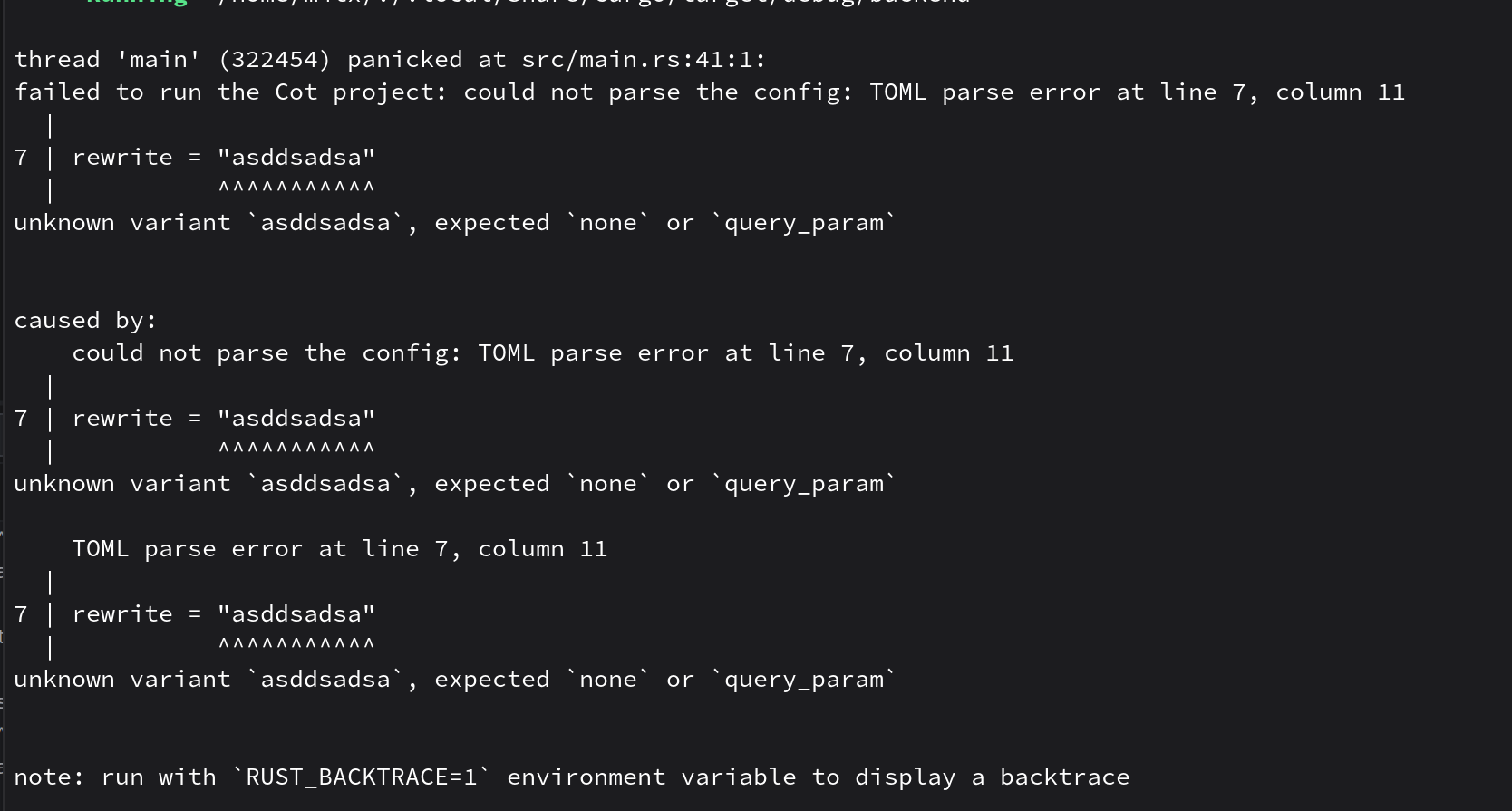
If you do need the raw Debug output - for example, in unit tests - you can still get it with the alternate formatter {:#?}.
Extra project configuration
ProjectConfig now has a catch-all extra field that captures any configuration keys Cot doesn’t recognise. This is the idiomatic way to add project-specific settings to the standard config/*.toml files without fighting the parser:
# config/base.toml
[]
= "UA-XXXXXXXXX-1"
= ["dark_mode", "beta_ui"]
use ;
use ;
async
Guide code snippets are now tested
As promised in the v0.6 blog post, all code examples in the Cot guide are now automatically compiled and tested as part of the CI pipeline. This means that the guide will never silently drift out of sync with the framework - if a change breaks a guide example, the build fails. This is a huge win for the maintainability of the documentation, and a proof that the documentation is a first-class citizen in Cot.
As part of the documentation improvements, the ORM guide has got an entire new page about making queries. We’ll be adding more content to the guide in the coming months, so stay tuned!
Other improvements
DatabaseUser::set_usernameandset_password: you can now update credentials on an existingDatabaseUserwithout recreating it. Remember to call.save(&db).awaitafterwards.Serialize/Deserialize/JsonSchemafor internal types:Auto<T>,LimitedString<N>,Identifier, and other internal types now implementserdeandschemarstraits, making it easier to expose ORM models directly via JSON APIs.Ord/PartialOrdforAuto<T>: you can now compare and sortAutovalues, which is useful when working with primary keys.- Route path normalisation: route paths without a leading
/are automatically normalised:"home"and"/home"now define equivalent routes. - Non-ASCII URLs: routing and URL reversing now correctly handle paths containing non-ASCII characters.
What’s next?
We have a bunch of ORM-related features on the roadmap, and we’re starting to plan a background task system for Cot. We’re also looking into the idea of releasing the 1.0 version at some point in the future, which would give users a promise for long-term stability. If you have any ideas for the first major release, let us know on the discussion page!
Ready to build? Head over to the Cot website for the updated guide.
As always, Cot is community-driven. Whether you want to report bugs, suggest features, or contribute code, every bit of help is appreciated. Join us on Discord to share what you’re building!
For the full list of changes, see the official release notes. Thank you to everyone who contributed to this release!